December 15, 2025•8 min read•By Maurits Dierick, Charter Broker & Former Yacht Captain
MYBA 2017 vs 2025: What Changed in the Latest Yacht Charter Agreement
The 2025 MYBA charter agreement introduced real changes to how charters are structured. Here is what changed, what stayed the same, and what it means for you.
MYBA 2017 vs MYBA 2025 Charter Agreement
What Actually Changed, and Why It Matters
Charter contracts are the quiet infrastructure of a holiday. When everything goes well, you never notice them. When something goes sideways, a delay at delivery, a late payment, a complaint after disembarkation, the contract becomes the only thing in the room. For years, most Mediterranean crewed charter transactions have relied on the MYBA 2017 form. In 2025, MYBA issued a revised version that keeps the familiar backbone, but adds modern compliance and reshapes a few pressure points.
This piece focuses on verifiable changes that appear in the contract text itself, plus limited context from industry commentary. If you only read one section, read the comparison table and the notes on KYC, confidentiality, sanctions, and how funds flow through the stakeholder.
A quick map of roles: who pays whom, and who holds the money The MYBA contract is structured around distinct roles. The Owner lets the yacht. The Charterer
hires it. The Broker arranges the charter. The Stakeholder is appointed to receive, hold, and disburse funds in escrow according to the agreement. Payments are described in two layers: what the Charterer owes (charter fee instalments, APA, delivery fees if any, security deposit), and how the Stakeholder then disburses those funds to the Owner, Captain, and others, under the contract rules.
A high-level comparison
Topic
MYBA 2017 (contract text)
MYBA 2025 (contract text)
Length and layout
Clauses 1-25. Described as eight pages plus special conditions or addenda.
Clauses 1-31. Described as ten pages plus special conditions or addenda.
New end-section clauses
No dedicated KYC, privacy, confidentiality, sanctions, or bank-compliance liability clauses.
Adds Clauses 26-31: KYC, data protection and privacy, confidentiality, sanctions, liability (bank or transfer delays), and miscellaneous (entire agreement, severability, third-party rights).
Stakeholder framing
Stakeholder used to hold and disburse funds; disbursement mechanics in Clause 20.
Defines Stakeholder and escrow mechanics in the definitions and retains the Clause 20 disbursement structure, adding language that payments should be made from the Charterer’s bank account as default.
Force majeure and verification
When force majeure is invoked in relation to breakdown or disablement, Owner provides a technical report, maintenance log if applicable, and supporting documentation.
Keeps the reporting requirement and adds a Charterer right to appoint a qualified or accredited surveyor to inspect the vessel and related documents when force majeure is claimed for breakdown or disablement.
Use of vessel conduct rules
Includes behavioural rules, harassment prohibition, a zero-tolerance policy for illegal drugs or weapons, and rendezvous diving only unless otherwise noted.
Retains the same core rules, clarifies termination mechanics, and explicitly includes zero tolerance for physical or sexual assault alongside the drugs and weapons provisions.
Browse the fleet
Crewed yachts for every kind of week on the water, from catamarans and sailing yachts to full-size superyachts.
1) The 2025 contract shifts from classic charter form to charter form plus compliance
The most important difference is not a glamorous one. It is paperwork. The 2025 form adds an explicit Know Your Client clause and links it to the ability of the Broker and or Stakeholder to receive and move funds. In plain language, the contract anticipates modern banking reality: before money moves, parties may need to prove who they are and where the funds come from.
In the 2025 wording, both Owner and Charterer must provide documentary evidence that banks or authorities may reasonably require. It also anticipates a common complication: if someone else remits funds on the Charterer’s behalf, that third party can also be pulled into the KYC net. If KYC cannot be satisfied and the parties cannot agree a replacement stakeholder within the timeframe stated in the contract, the agreement can be cancelled within the clause framework.
2) Confidentiality becomes explicit, and it lasts
The 2017 form includes a confidentiality duty on the Captain and Crew regarding information related to the charter and the parties. The 2025 form adds a dedicated confidentiality clause that is broader, covering the terms of the agreement, documents executed under it, ownership information, and the identities of the Charterer and Charterer’s party, with limited carve-outs for legal requirements and for performing the agreement. It also states that the confidentiality obligations survive fulfilment, cancellation, or rescission without limit in time.
3) Sanctions are now a contractual front door
The 2025 form adds a sanctions clause with defined terms for sanctions and sanctioned parties. It frames sanctions compliance as a continuing warranty by Owner and Charterer and creates an express termination pathway if a party is in breach. It also addresses a practical scenario: if sanctions-related restrictions on fund transfers arise, the Broker and or Stakeholder may hold funds until payment or return is confirmed lawful or a competent authority directs otherwise.
4) How money moves: due by whom, to whom, and when
The MYBA form separates obligation from mechanism. The Charterer’s obligation is to pay the amounts listed on Page One, including charter fee instalments, APA, delivery and re-delivery fees if agreed, and the security deposit, by the due dates, in cleared funds. The mechanism is that these
funds are held in escrow by the Stakeholder and disbursed according to Clause 20.
Both the 2017 and 2025 versions retain the same headline disbursement structure: fifty percent of the charter fee is paid to the Owner at the start of the charter period (or first working day after), and the balance after completion, unless a complaint is notified, in which case a retention period applies. The 2025 wording modernises and clarifies parts of this flow, including that payments should be made from the Charterer’s bank account as default and that the stakeholder retention can continue if arbitration is commenced and notified.
5) Force majeure: the 2025 form adds an inspection right
Both versions require the Owner to provide a technical report and supporting documentation when force majeure is invoked in relation to breakdown or disablement. The 2025 version adds an explicit right for the Charterer to appoint a qualified or accredited surveyor to inspect the vessel and relevant documents, with prompt access required, when force majeure is claimed in this context.
Ready to start planning?
Tell us what you have in mind and a broker will put together a tailored selection, with honest review notes and walkthrough videos.
6) Behaviour and serious breach language is sharper
Clause 13 exists in both versions and includes rules on respect for the crew, restrictions on commercial filming without permission, smoking restrictions, and the long-standing position that only rendezvous diving is permitted unless otherwise noted under special conditions. The 2025 version clarifies that certain serious breaches, including zero-tolerance provisions, can justify immediate termination without the warning step described elsewhere in the clause.
Two realistic scenarios, without the drama
Scenario one: a charter starts late. Under both versions, a short delay caused by force majeure can lead to a pro rata refund or a pro rata extension. The 2025 form adds that any pro rata refund is deducted and paid by the Stakeholder to the Charterer before disbursement of the charter fee to the Owner.
Scenario two: a banking delay slows a wire transfer. The 2025 form introduces a limitation of liability for the Broker and or Stakeholder for delays or failures to transfer amounts caused by their banks or intermediary banks, where those delays arise from compliance with anti-money laundering, anti-corruption, and counter-terror financing regulations and internal procedures. This does not remove any party’s obligations under the contract, but it does allocate risk and expectations about transfer friction.
What did not change, and why that matters
The core charter machinery remains recognisable between 2017 and 2025: delivery and re-delivery obligations, cruising area limits, the captain’s authority, operating costs and APA mechanics, breakdown remedies, complaints handling and arbitration, and the stakeholder escrow structure. That continuity is deliberate. The 2025 update modernises around the edges without rewriting how charters are actually run.
At Frontier Yachting, we believe that confidence is the foundation of a great charter. Not because clients want to read contracts line by line, but because they deserve to understand the framework that supports their experience.
Charter agreements are not designed to complicate a journey. When used properly, they remove uncertainty, align expectations, and ensure that everyone involved is working toward the same outcome: a seamless, well-run charter.
Our role is to guide clients through that framework with clarity and discretion, so the focus remains where it should be. On the yacht, the destination, and the time spent at sea.
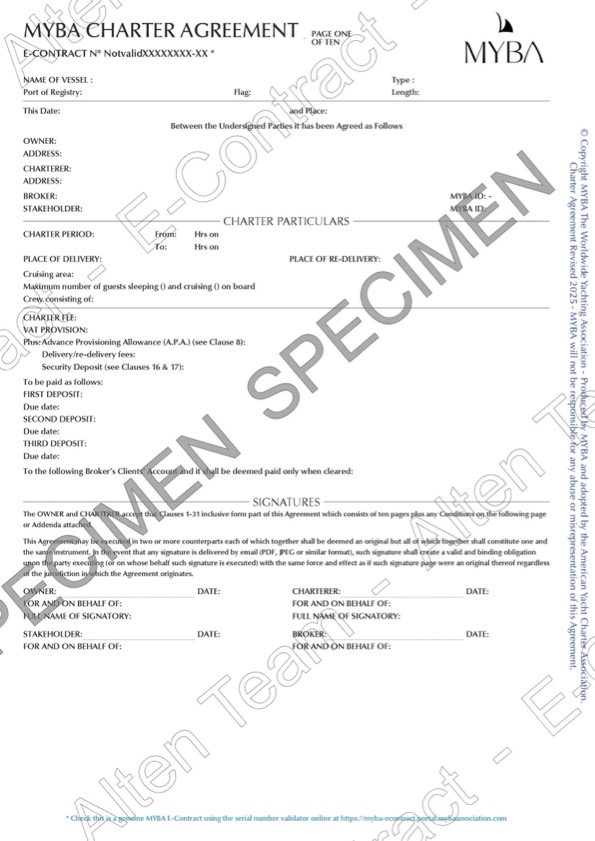
MYBA 2025 contract specimen, page 1 of 10
Disclaimer: This article is intended as an educational overview of selected changes between the MYBA Charter Agreement issued in 2017 and the MYBA E-Contract introduced in 2025. It is provided for general informational purposes only and does not constitute legal advice.
Nothing in this article is intended to criticise, endorse, or replace any charter agreement, association, or contractual framework. Readers should always rely on the fully executed charter agreement applicable to their specific charter.
Charter agreements may be amended, supplemented, or modified by special conditions, addenda, or governing law. Charterers and owners are encouraged to review the complete contract carefully and seek independent legal advice where appropriate before entering into any binding agreement.
MYBA contractMYBA 2025MYBA 2017vs2025MYBA charter contractCharter contract